What happens afterwards
Witnessing a cremation, and identification
Some families want to see the person one last time before the cremation, and some want to be present when it begins. Both are ordinary requests and neither is unusual to ask for.
What this includes, and what it does not
The first column is ours to do and ours to charge for. The second is either somebody else's charge — the cemetery, the crematory, the clergy, the newspaper, the airline — or it is a thing this arrangement genuinely does not involve. Anything bought on your behalf is passed on at what it costs us.
What this includes
- A short private identification viewing beforehand, for as few or as many as you wish
- Attendance at the crematory, in a room set aside for it
- A rental casket for the viewing, so a casket does not have to be bought to be burned
What it does not
- Any obligation to do either. Most families do neither and are content.
The part we would rather you heard from us
Several faiths ask that a family member starts the cremation. The crematory will arrange it and we will ask on your behalf; tell us early, because it needs a slot rather than a queue.
Two different requests, often confused
An identification viewing is short and private. The person is brought to a room, the family — or one member of it, or six of them — sees them, and that is all. It answers the question that some people cannot put down until it is answered, and it takes minutes rather than hours. It can happen here or at the crematory.
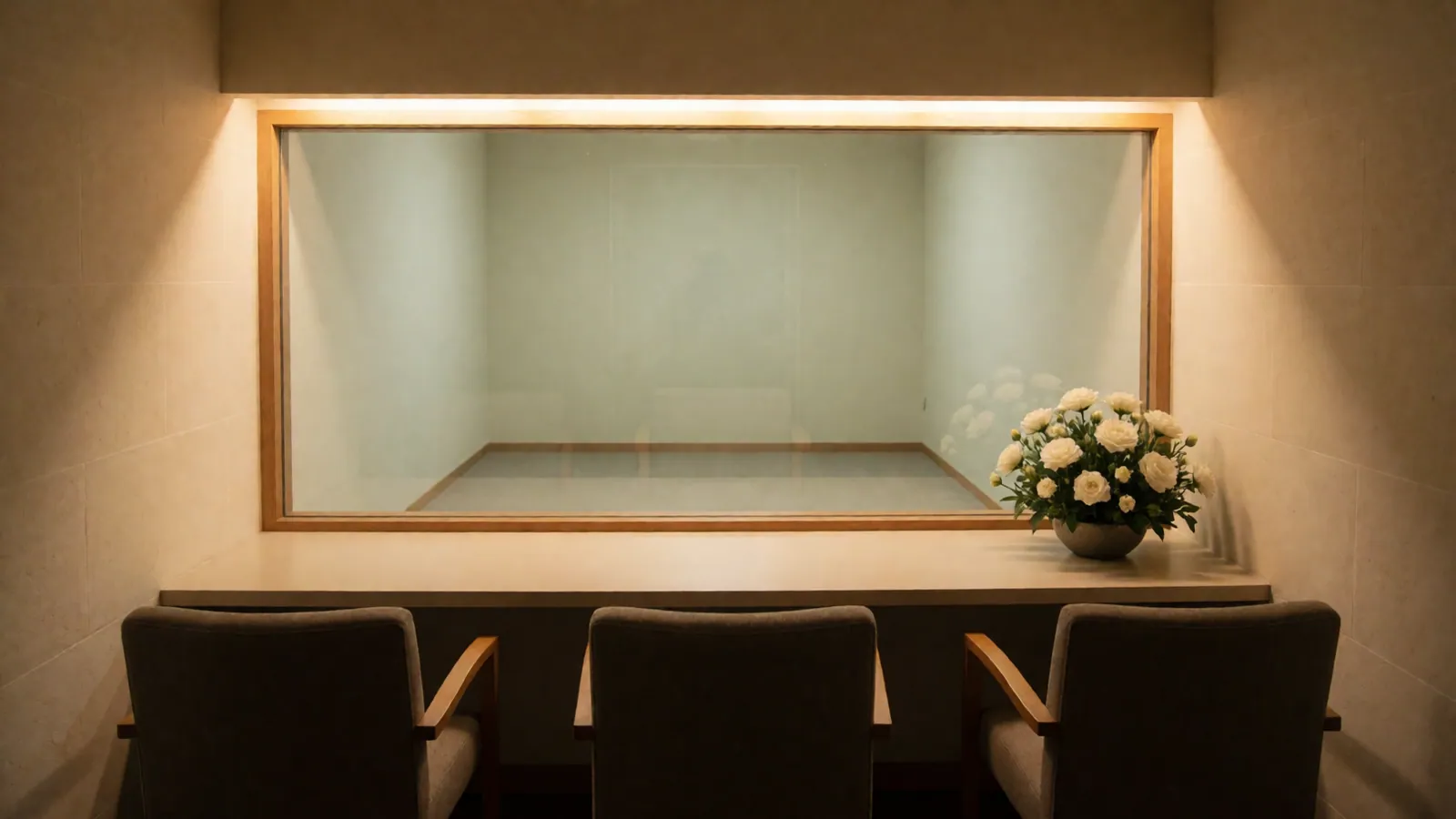
Witnessing is being present at the crematory when the cremation begins. There is a room set aside for it, usually with a window or a screen onto the charge, and it is usually a handful of people for a few minutes. Both are ordinary requests, both are arranged regularly, and neither is unusual to ask for.
The rental casket, and why it exists
For a viewing before a cremation there is a casket built in two parts: an outer shell, which is used for the viewing and then returned and used again, and an inner container which is what actually goes into the cremator. A family gets the appearance of a casket for the hours it is wanted, and buys only the container.
It exists precisely so that a casket does not have to be bought in order to be burned, and it is one of the things families are least often told about. Ask to see it, at any funeral home. If you are told a casket must be purchased for a cremation, that is not correct.
Starting the cremation, where a faith asks it
Several faiths ask that a family member — a son, the eldest child, a named relative — begins the cremation themselves. Crematories do this and there is nothing remarkable about it, but it needs a booked slot at a named hour rather than a place in the day's queue, and slots at the hours families want are limited.
So tell us in the first conversation rather than at the end of it. It is the single most common reason a cremation has to move by a day, and it is entirely avoidable. Where a rite has to be performed beforehand, tell us what it needs and how long it takes, and we will ask the crematory on your behalf. Nobody here will assume they know what your tradition requires.
Most families do neither, and are content
This is the honest end of the page. The great majority of families do not attend a cremation, do not ask for an identification viewing, and have no regret about it afterwards. Neither request is a duty and neither is a mark of anything.
They are here because some families want them, some faiths require them, and a family that does not know they are possible cannot ask.
What we do not do
Every one of these is short, and every one of them is here because a family somewhere was told the opposite of it on the day of a funeral.
If your family needs to be there, say so early
A witnessed cremation and a rite performed beforehand both need a booked hour rather than a place in the queue, and the first conversation is when to tell us.