About
How these pictures were made
Every photograph on this site was generated rather than taken. This is what is in them, what is deliberately not, and why each of those was a decision.
The photographs on this site were generated rather than taken. There is no building to photograph, and a stock library picture of a real funeral would be a considerably worse answer. There is a page about how it was done and what is deliberately not in any of them.
A funeral home's website is mostly photographs, and photographs are where a site of this kind does its quiet lying. So it is worth setting out, once and in one place, what these ones are.
Why they were generated rather than photographed
There is no building on 61st Street to photograph, because this business does not exist. That left two honest options and one dishonest one.
The dishonest one is the usual one: buy stock photographs. The library is full of them — a hand on a shoulder at a graveside, a woman in black being comforted by a man in a suit, a coffin under flowers with a family behind it out of focus. Those are photographs of real people, most of them models but not all, and using somebody else's worst hour to advertise a funeral home that has never buried anybody is a use nobody in the frame agreed to. It is also the reason every funeral home's website looks the same.
The option taken instead was to generate the rooms, and then to say so on this page rather than hoping nobody asked. Each rule below costs the site a picture it would otherwise like to have, which is how you can tell it is a rule rather than a preference. In short:
- Nobody grieving appears in any frame, anywhere, at any distance.
- No face is ever presented as a person who has died.
- The only people on the whole site are the six staff portraits.
- There is no casket and no urn in any picture.
- No inscription is legible anywhere, and no monument is the subject of a frame.
- There is no signage of any kind, including on the front of the building.
- There is no religious symbol in any room, because the chapel has none.
Nobody grieving is in any frame, anywhere
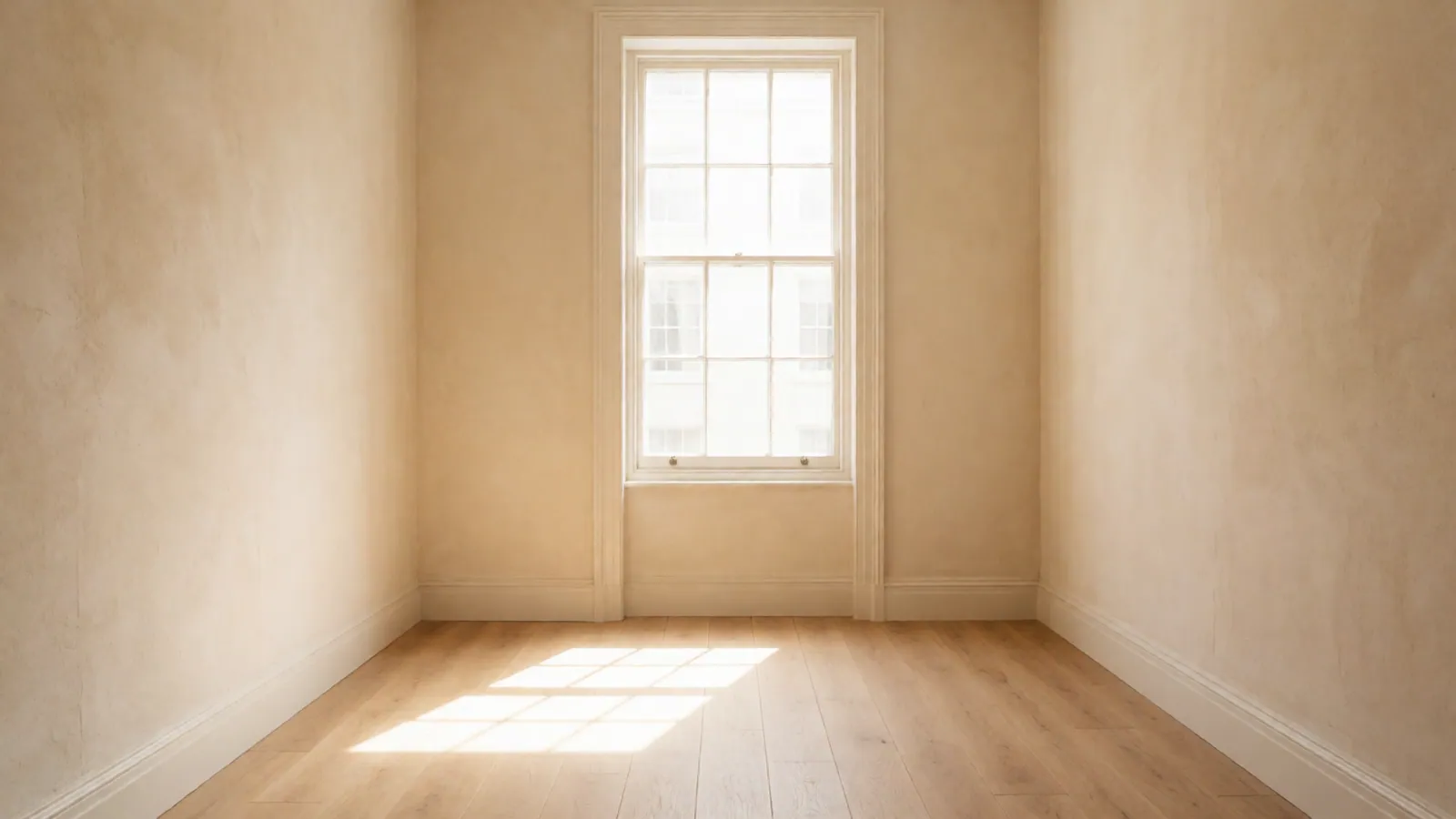
This is the line the whole set was built around. No mourners, no funeral in progress, no coffin with people standing round it, no child at a graveside, no hand on a shoulder. Every room on this site is empty and every chair in it is unoccupied.
The reason is simple enough to say in one sentence: a site that shows somebody's worst day is watching it. A generated one is worse, not better, because it is an invented grief made to sell something, and a family reading this website at three in the morning should not have to look at a picture of themselves.
The empty rooms are also, as it turns out, the more accurate picture. What a funeral home actually is, most of the time, is quiet rooms waiting.
No face is ever presented as a person who has died
Not in the obituary template, not in a memorial card, not as a photograph on a stand at the front of the chapel. A generated face attached to an invented death is the one output this project would not ship under any circumstances, and the sample notices are built around its absence: a dash where the name goes, a dash where the dates go, and no portrait at all.
The only people on this site are the six staff portraits
Those are living professionals photographed as professionals: standing in a room, looking at the camera, doing the job the page says they do. That is the one category of person a site like this can honestly show, and it is the only one shown here. Nobody else appears in any frame, at any distance, in focus or out of it — not a figure at the end of a corridor, not a silhouette in a doorway, not a congregation seen from the back.
There is one other frame in the set with a person in it at all, and it is a pair of hands. No face, no context and nobody it could be. Hands are the one exception the brief allows, and it stayed at exactly one.
The portraits carry nothing on the lapel: no badge, no pin, no name tag, no embroidery. That is not a styling choice. A lapel is precisely the shape that invites an association pin, and this site claims membership of nothing, so the pictures had to agree with the words. It is the same reason there is no certificate on any wall in any frame.
There is no casket and no urn in any picture
This one surprises people, and there are two reasons for it. The second is the real one.
The first is technical. Both objects carry lettering as a feature of themselves — a maker's badge inside a casket lid, an engraved plate on the front of an urn — and a generator asked for one will supply the lettering too, in the confident nonsense it writes instead of words. There is no way to instruct it not to. An object that invites text has to leave the frame rather than be told to behave.
The second reason is the argument. A photograph of a casket is a photograph of a purchase, and the whole claim of this site is that the purchase is the smallest part of what a family is actually deciding. The selection room is described in words instead, on the page about the building. Architecture and flowers carry the trade here, which is also what the good funeral homes do.
No inscription anywhere, and no monument that is the subject of a picture
An inscription is the entire point of a headstone, so a generated one would be an invented name, with invented dates, on an invented grave — the same object as a fabricated obituary, in stone. The cemetery pictures were therefore made as lawns, avenues, gates, hedges and paths, which turned out to be the more dignified picture and the one most families would rather look at anyway.
That rule then had to be corrected, and the correction is worth reading because it is the part most sites would quietly leave out. Three of the cemetery frames came back with distant headstones under the trees — unfocused, small, without a legible mark on any of them, which is simply what a cemetery looks like from a gate. They were kept, and the rule was narrowed to what is actually true and can actually be checked: no inscription is legible in any frame, and no monument is the subject of any frame. None is in the foreground, none is in focus, and none is named in the words under any picture.
The narrowing rather than the deletion is deliberate. The hazard was never the stone; it was the lettering. Claiming the stronger rule while shipping the weaker one would have been exactly the kind of thing this page exists to stop — a promise nobody checked, about photographs nobody looked at.
The same lettering rule removed the ribbon from every flower arrangement: no sash, no card, no name spelled out in carnations, just loose flowers in a plain vessel.
There is no sign, and no front of the building
A real funeral home has its name in large letters on the fascia, on a board at the kerb and along an awning. There is no frontage shot anywhere on this site. The portico is photographed from underneath it looking at the doors, the building at dusk is the garden side at an angle, and the street pictures look away down the block.
The narrow reason is again that generated text comes out as text-shaped nonsense. The wider one is that a sign is a claim, and a photograph of a sign is a photograph of a business that exists.
Three more things went the same way and for the same reason. There is no paper in any frame: no order of service, no register book, no memorial card, no label on any folder, and the reading stand on the obituaries page is bare. There is no vehicle in any frame, because a hearse carries a livery name along its side and a plate on the back — the covered porch is photographed with nothing standing under it. And no book on any shelf faces the camera.
The chapel walls are bare because the chapel walls are bare
There is no religious symbol in any room in any picture: no cross, no star, no crescent, no icon. That is not a rendering convenience and it is not an attempt to offend nobody.
This chapel belongs to no denomination and has nothing on its walls, so that a family can bring what they want and take it away afterwards. That is a fact about the business, stated in words elsewhere on this site, and the photographs have to agree with it. A picture that quietly added a cross to the end wall would be a picture of a different building, and the sentence on the chapel page would become untrue without anybody editing it.
What this means for you, reading it
If you are looking at this site as somebody who might buy one: the rooms are a design, not a portfolio of a real interior, and none of these pictures is evidence of anything. That is the honest version, and the pictures on the site you buy would be of your own building.
If you are here because somebody has died: none of this matters to you at all, and the number at the foot of the page is not answered. Ring a real funeral director in your area.
The pages these pictures belong to
Everything above is a rule about photographs. These are the pages where the same argument is made in words.
- The family — who this business is meant to be, and since when.
- The people here — the six portraits, and what is said and not said under each one.
- The building — the rooms, including the ones deliberately not photographed.
- Obituaries and notices — the template with nobody in it.
If you are here because somebody has died
Nobody answers the telephone number on this site. Please call a real funeral director in your area, at any hour — they expect the call and they will not mind the time.