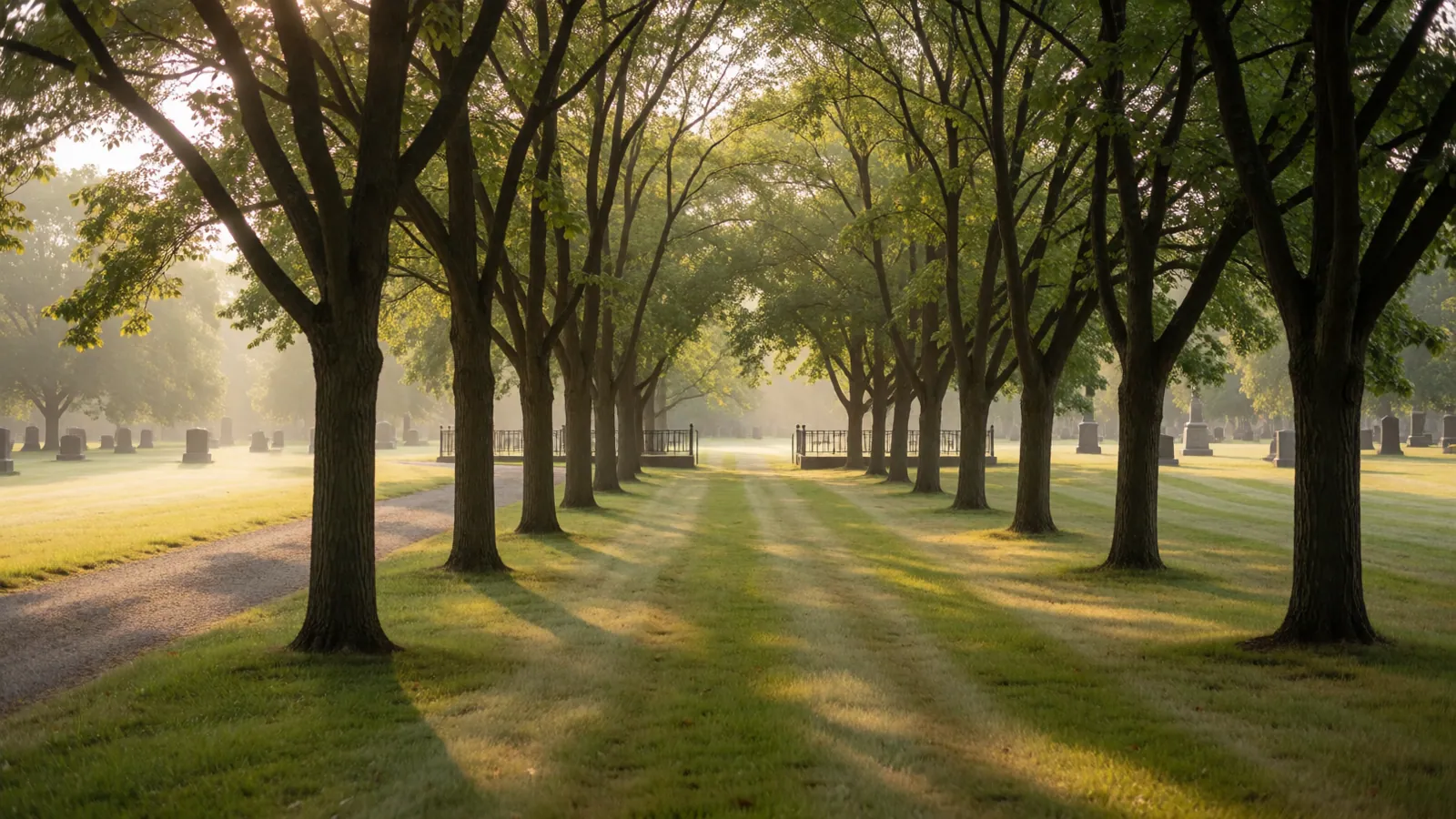
What happens afterwards
Burial
What we do, and what the cemetery does, are two different bills and two different diaries. Knowing which is which is most of what makes this part confusing.
What this includes, and what it does not
The first column is ours to do and ours to charge for. The second is either somebody else's charge — the cemetery, the crematory, the clergy, the newspaper, the airline — or it is a thing this arrangement genuinely does not involve. Anything bought on your behalf is passed on at what it costs us.
What this includes
- Preparing and dressing the person, and the casket you have chosen
- The hearse, the bearers and the procession
- Filing for the permit that lets the burial happen at all
- Being at the cemetery with you, and dealing with its office so you do not have to
What it does not
- The grave itself, its opening and closing, and the cemetery's perpetual care charge
- The outer container the cemetery may require around the casket
- The headstone, which is a monument dealer and usually months later
The part we would rather you heard from us
If the family already owns a grave, find the deed before you do anything else. Most of the delay in a burial is the cemetery confirming who owns the plot and who has the right to open it, and that is a question we cannot answer for you.
If the family owns a grave, find the deed today
This is the first job and it is a job for the same day, before the funeral is discussed. A grave has an owner, the owner is named on a deed, and no cemetery will open a grave without knowing who that owner is and that they agree. Where the named owner has died, the right passes to somebody, and the cemetery has to be satisfied who.
Where the paper turns up: a safe deposit box, a deed box with the house papers, the folder that holds the marriage certificate, an old handbag at the back of a wardrobe, a lawyer's file, or taped inside the cover of a photograph album. If nobody can find it, ring the cemetery office with the family name and the rough year of the last burial — their records are usually far better than the family's, and a telephone call on the first morning saves the week that this otherwise costs.
Opening and closing
This is the cemetery's work and not ours: its own crew opens the grave and closes it, and it is charged every single time — a second burial in the same grave twenty years later is charged again, at whatever it costs then. The charge commonly differs by the day of the week, and a weekend or a public holiday costs more than an ordinary weekday.
It is booked in the cemetery's diary and not in ours, and the diary is usually what decides the day of a funeral rather than anything at this end. That is also why nobody here can promise you a date until the cemetery has agreed to it.
The outer container is the cemetery's rule
Many cemeteries require a liner or a vault around the casket so that the ground does not settle and the lawn stays level enough to mow. Whether one is needed at all, and of what kind, is that cemetery's rule. It is not a state law and it is not our preference, and it is a question to ask the cemetery before you choose anything else.
Nothing about an outer container preserves anybody, and nobody should sell you one on that basis — this is the claim that gets made obliquely more than any other in this trade.
The headstone is months later, and a different trade
A headstone comes from a monument dealer, not from a funeral home. The ground has to settle before a stone can stand on it, which is commonly six months to a year, and in that time the cemetery's own rules decide what is allowed: the size, the material, the colour, whether it stands up or lies flat, and sometimes the lettering. The concrete foundation it stands on is usually the cemetery's charge and not the dealer's.
Nobody should be choosing a stone in the first week and nobody should be selling one to a family in the first week either. A temporary marker goes on the grave meanwhile, at no charge, so that people can find it.
Which bill is whose
Ours: the transfer into our care, preparation and dressing, the casket if you buy it here, the hearse and the bearers, the filings and the permit, the rooms and the staff for whatever service you have chosen, and being at the cemetery with you.
The cemetery's, and not ours: the grave itself, its opening and closing, the outer container if it requires one, the perpetual or annual care of the plot, the foundation for a stone, and any surcharge for the day. Those are set by the cemetery, we pass them on at what they cost, and we add nothing to them — we do not sell the grave, and the shape of the cemetery's own bill is here. It is frequently the larger of the two.
Worth asking, of us or of anybody else
- Does the family already own a grave, and where is the deed?
- Who is named on that deed, and are they living?
- How many burials has that grave already had, and how many more will it take?
- Does the cemetery require an outer container, and of what kind?
- What does that cemetery charge for the day of the week you have in mind?
What we do not do
Every one of these is short, and every one of them is here because a family somewhere was told the opposite of it on the day of a funeral.
The first job is the deed, and it is a job for today
If anybody thinks the family owns a grave, start on that before anything else is decided. We will ring the cemetery office with you if it helps.