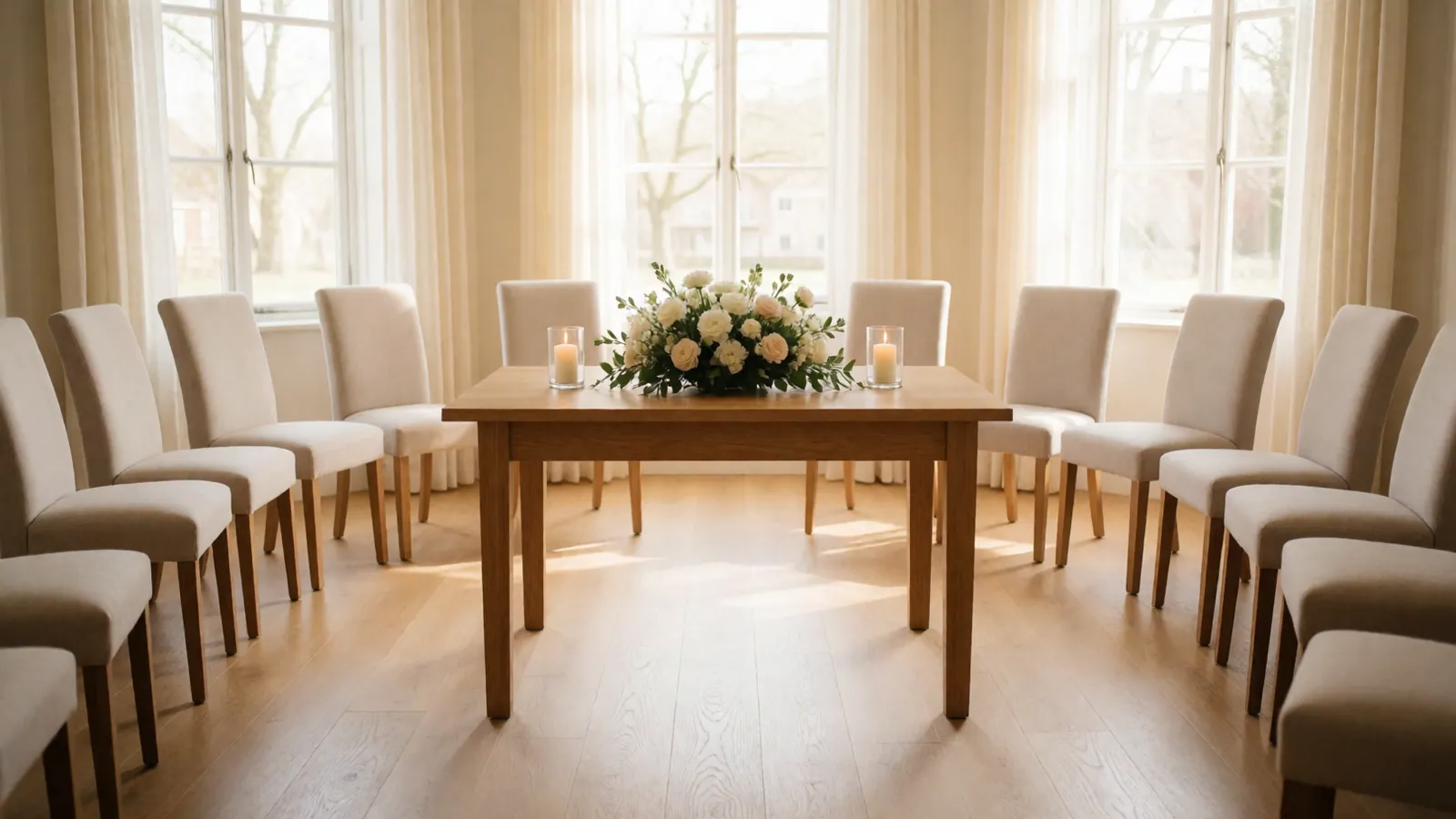
The gathering
A memorial service, without the body
The same gathering, held after the burial or the cremation has already happened. Nothing about it is second best; it simply separates the practical part from the remembering.
What this includes, and what it does not
The first column is ours to do and ours to charge for. The second is either somebody else's charge — the cemetery, the crematory, the clergy, the newspaper, the airline — or it is a thing this arrangement genuinely does not involve. Anything bought on your behalf is passed on at what it costs us.
What this includes
- Any date you like — a week later, a month later, in the spring when people can travel
- The chapel, the reception room, or a place of your own choosing
- The ashes present or not, exactly as you prefer
- A gathering afterwards here, with tea and something to eat
What it does not
- Anything time-critical: this is the one arrangement with no clock on it
The part we would rather you heard from us
Families who choose direct cremation and then hold a memorial in their own time often describe it as the version they would choose again. We say that because it is what we hear, not because it is cheaper for you or better for us.
Why separating the two parts works
In the week after a death a family is registering the death, finding documents, answering the telephone every twenty minutes and making decisions it has never made before. Holding the gathering in the middle of that week is possible — most families do it — but a great many of them afterwards describe the day itself as something they were present at rather than something they remember.
A memorial takes the remembering out of that week. The practical part happens on its own timetable, driven by the certificate, the permit and the cemetery or crematory diary. The gathering happens when the people who matter can be in the room and the family can hear it. Nothing is lost by separating them and nothing about it is second best.
When: a fortnight, a month, the spring
There is no rule and there is no deadline. A fortnight later is common. A month is very common. Waiting for better weather, for a school holiday, for a birthday or for the anniversary is all ordinary, and a memorial held a year later is not a late funeral — it is a different thing that families find easier to bear.
This is the one arrangement with no clock on it at all. There is no permit waiting on it, no cemetery diary and no crematory queue. The only calendar that matters is the one belonging to the people you want in the room.
The ashes, present or not
Either is normal. Some families put the urn on a table at the front, some put a photograph there instead, and some have nothing at the front at all. If the ashes are going to be present, do not fix the date until they are actually back — a crematory's return can slip by a few days and a memorial built around them then has to move.
If the memorial ends with burying or placing the ashes, that is a cemetery booking with its own diary and its own charges, and it should be made before the invitations go out rather than after.
The relatives who have to travel
A funeral gives a cousin in another country about four days' notice. A memorial gives them four weeks. That is the difference between somebody buying a fare at whatever it costs, or not coming at all, and somebody arranging leave from work and arriving without having spent a month's money to do it.
Say the date out loud early, even while it is still provisional, and say it in the notice. Anybody applying for a visa needs longer than that, and needs something in writing with a date on it. If somebody is in that position, tell us at the start.
The version we hear about afterwards
The arrangement described to us most often as the one a family would choose again is a direct cremation followed by a memorial some weeks later. It gets said twice: once about what it cost, and once about the timing. The timing is the part they mean.
We say that because it is what we hear and not because it is better for us. It is not. It is the least we are ever asked to do.
What we do not do
Every one of these is short, and every one of them is here because a family somewhere was told the opposite of it on the day of a funeral.
A memorial is the one arrangement with no clock on it
Nothing about it has to be settled this week, or this month. When you have a date in mind, or only a season, that is enough to start with.