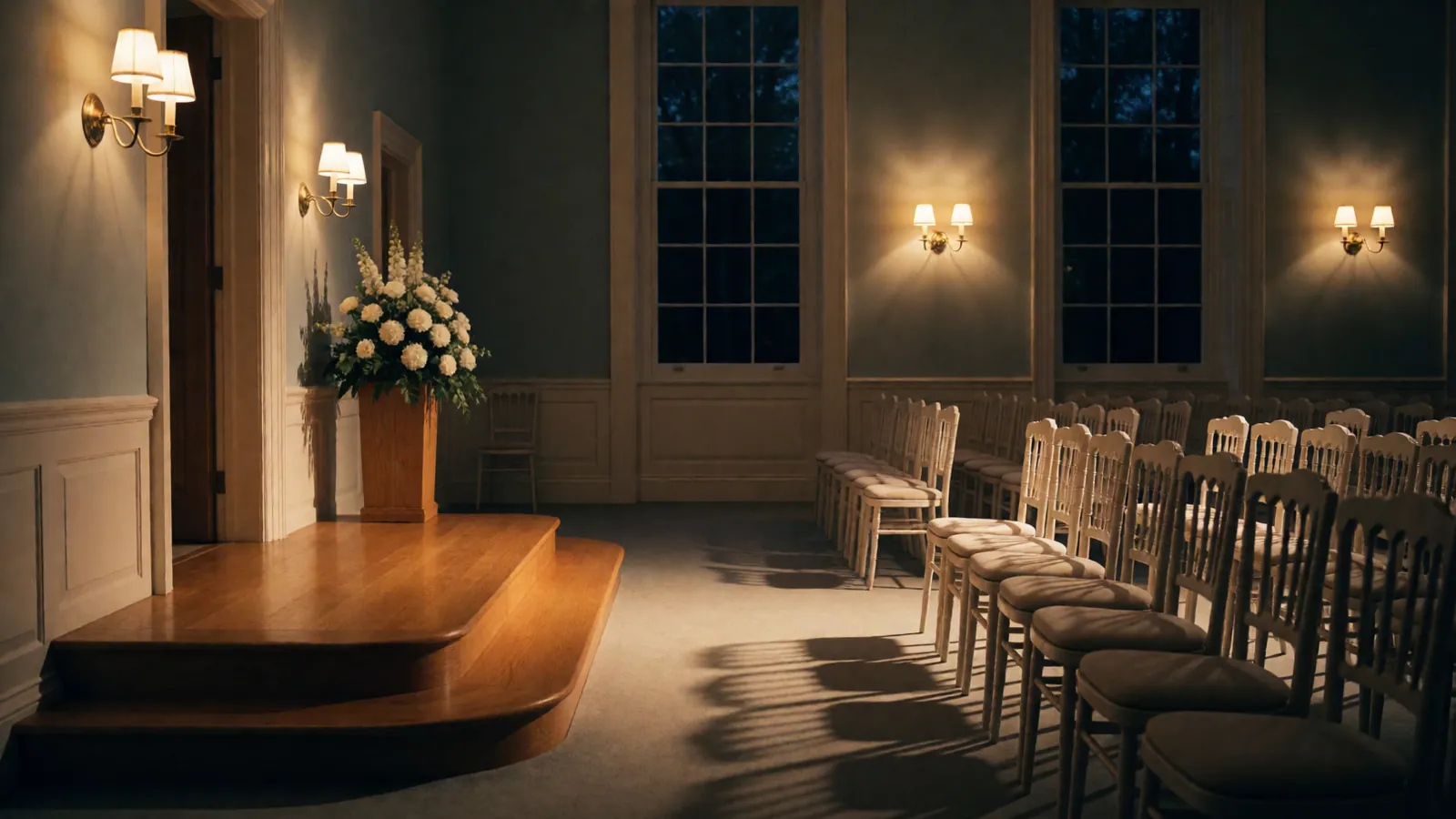
The gathering
A funeral service, with the body present
The service most people picture: the body is present in the room, the family is seated at the front, and afterwards everyone travels together to the cemetery or the crematory.
What this includes, and what it does not
The first column is ours to do and ours to charge for. The second is either somebody else's charge — the cemetery, the crematory, the clergy, the newspaper, the airline — or it is a thing this arrangement genuinely does not involve. Anything bought on your behalf is passed on at what it costs us.
What this includes
- The chapel here, or we take the service to your church, temple, mosque or gurdwara
- A viewing beforehand, on one or two evenings, if you want one
- Bearers, the hearse, and cars for the family
- Someone from here at every stage, so nobody is left wondering what happens next
What it does not
- The grave, which the cemetery sells
- The clergy or celebrant, whom you choose and we pay on your behalf
- Flowers and notices, which we order for you and pass on at what they cost us
The part we would rather you heard from us
It is the most expensive of the shapes and the one that takes the most arranging. It is also the one people most often say afterwards that they were glad of. Both of those are true and neither is a reason on its own.
The order of the day, from the first car to the last
A funeral day has four parts and they run in the same order almost every time. People gather. There is a service. Everybody travels. There is a short committal at the grave or at the crematory, and then it is over.
The gathering is twenty minutes to half an hour of people arriving, finding the door, finding each other and sitting down. The service itself is most often between thirty and fifty minutes; an hour is long and nobody minds twenty-five minutes. The journey is however long the journey is, and it is the part that goes wrong, because a procession moves at the speed of the slowest car in it. The committal at the graveside or at the crematory is short — usually under fifteen minutes and sometimes five.
The family is asked to come half an hour before anybody else, to a room with the door shut. That half hour does more work than any other part of the day. It is when people see the person for the last time without a room of mourners watching them do it, when somebody decides who is walking in with whom, and when whoever is speaking reads their page over one more time. Take it. Families who arrive with everybody else spend the whole service catching up with themselves.
Who carries, and how many
six bearers is the usual number and it is usual because of the weight and the width of a doorway rather than for any other reason. four is fine and is often better: a narrow chapel aisle, a set of steps, or a lighter person all argue for fewer people trying to occupy the same space. Our own staff carry if nobody in the family wants to, and a mixture is ordinary — two of ours at the front, where the weight is, and the family behind.
Nobody has to carry, and a person who says yes and then finds they cannot do it should be able to change their mind on the morning without anyone making a thing of it. Ask the day before rather than on the day. Tell whoever is carrying to be at the back of the chapel a few minutes before the end, because being called from the third row is the one moment of a funeral that can be genuinely undignified.
Music, readings, and who speaks
Most services carry two or three pieces of music: one while people come in, one in the middle where nobody has to say anything, and one to walk out to. Recorded music is entirely ordinary and has been for years. A hymn needs either an instrument or one confident voice near the front, because a room of people who half know a tune will stop singing by the second line if nothing is leading them.
two readings is usual and three is plenty. A eulogy that reads for five minutes on paper takes longer than that out loud, and it is the piece most likely to be abandoned halfway. Two things make that survivable: print it in a size you can read without your glasses, and give a copy to somebody else who is willing to stand up and finish it. Nobody has ever regretted keeping it short.
It does not have to be held here
A funeral service can be held wherever the family wants it held: a church, a temple, a mosque, a gurdwara, a hall, a garden, a cemetery's own chapel, or here. We take the service to you, and taking it somewhere else changes the travelling and the timing rather than the arrangement.
What we do not do is lead it. The priest, the imam, the pandit, the granthi or the celebrant is yours, and we work to whoever it is — here is why. If you have nobody, we will find somebody who does it well and let you decide.
Worth asking, of us or of anybody else
- Who is carrying, and have they been asked out loud rather than assumed?
- Who is speaking, and who will finish it for them if they cannot?
- Which music, in what order, and is anyone leading the singing?
- Is anyone coming who cannot manage steps, or who will need to sit at the back near a door?
- Where are people expected to go afterwards, and does the notice say so?
What we do not do
Every one of these is short, and every one of them is here because a family somewhere was told the opposite of it on the day of a funeral.
If you are working out whether to have a service at all
It is a question with no wrong answer, and nobody here will push you towards the larger one. Describe the family on the telephone and we will tell you what the day would actually involve.